
Last updated October 30, 2026
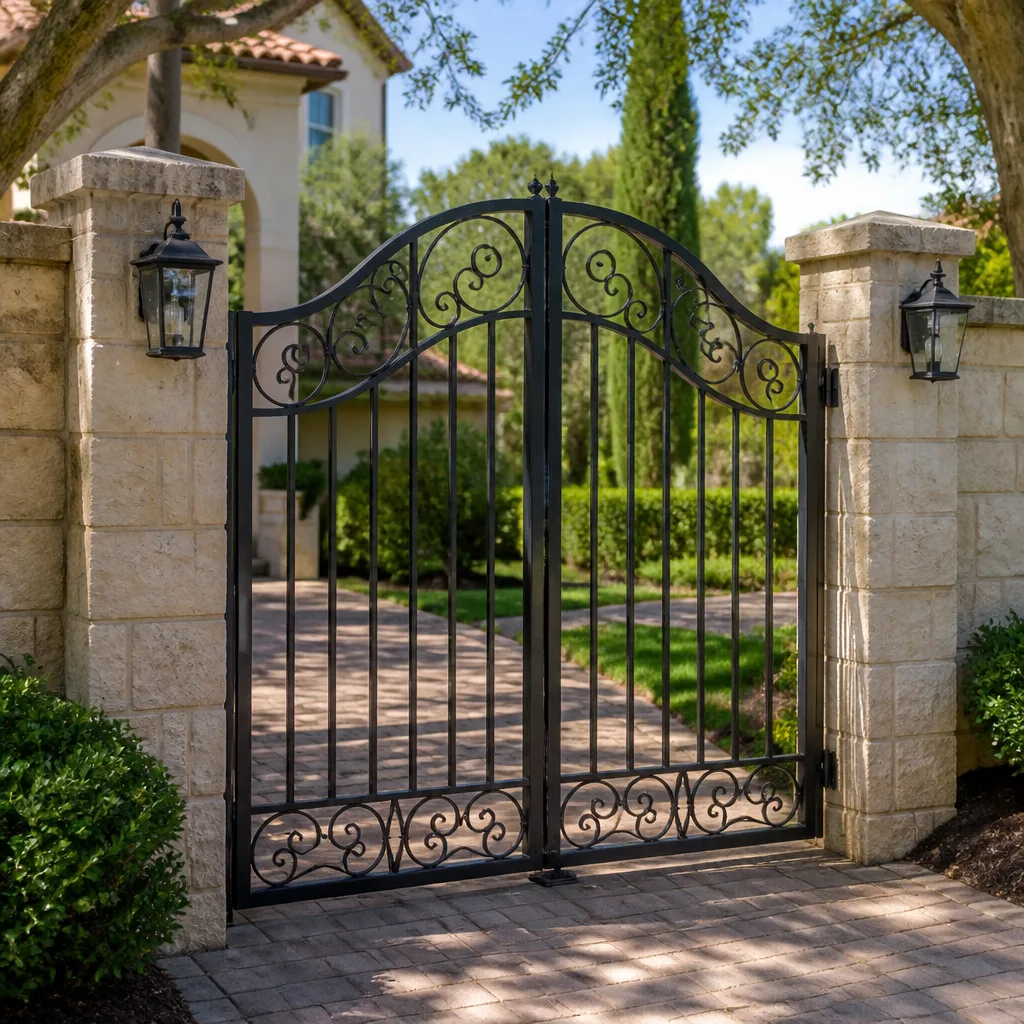 Wrought iron
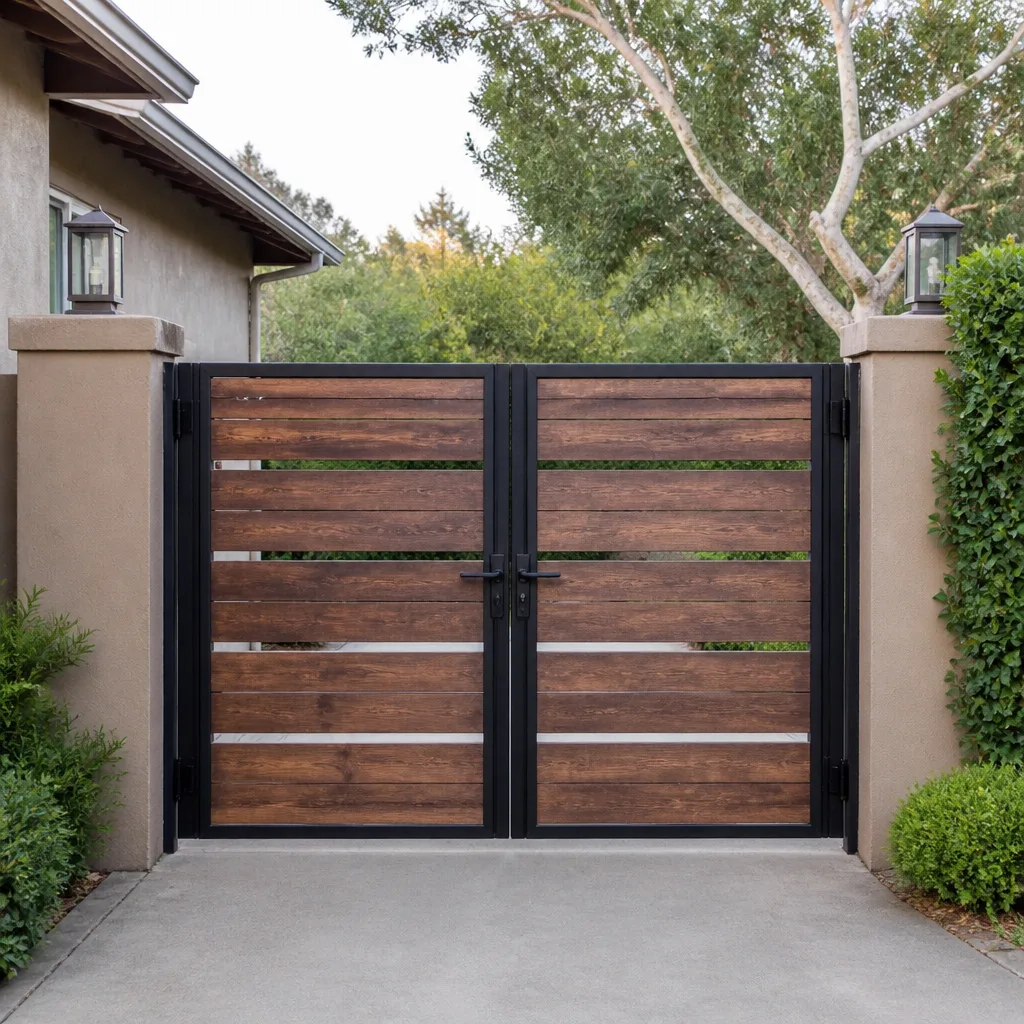 Wood & steel frame
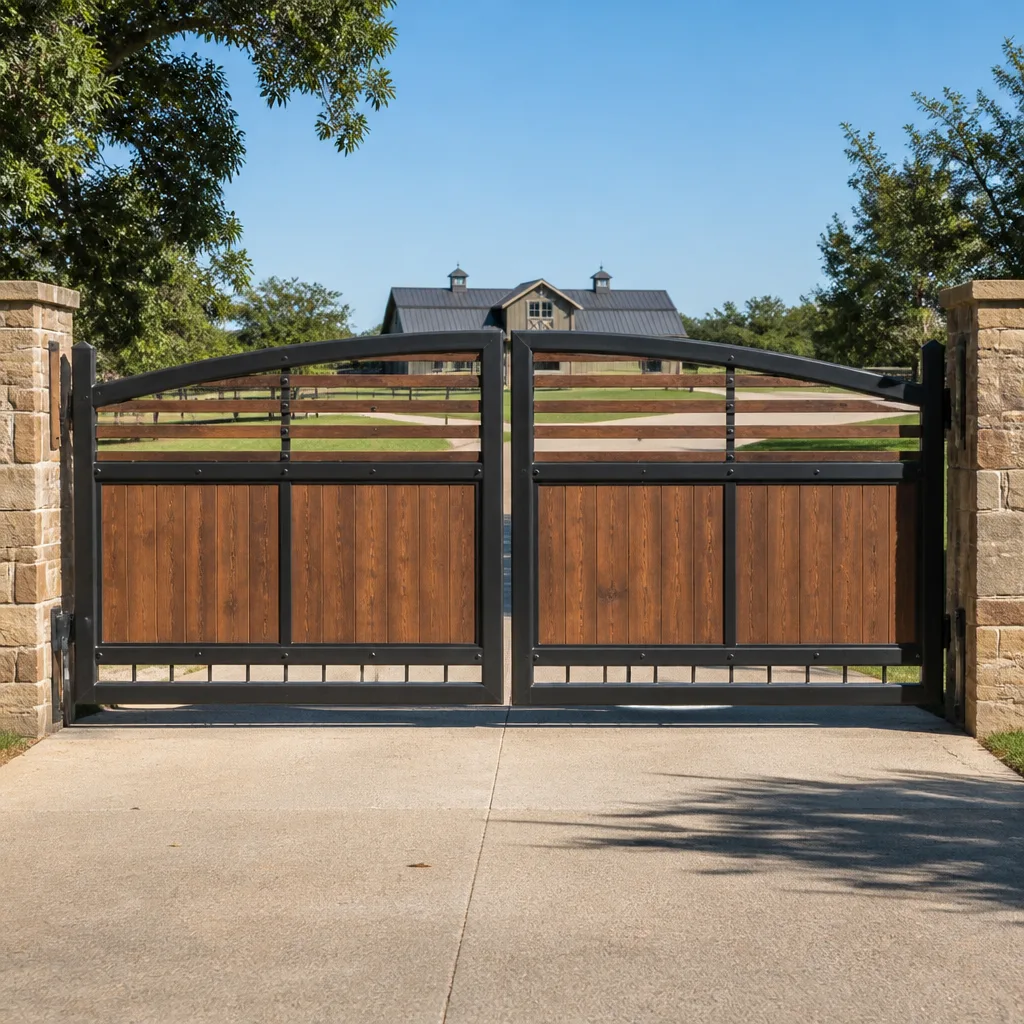 Farm & ranch
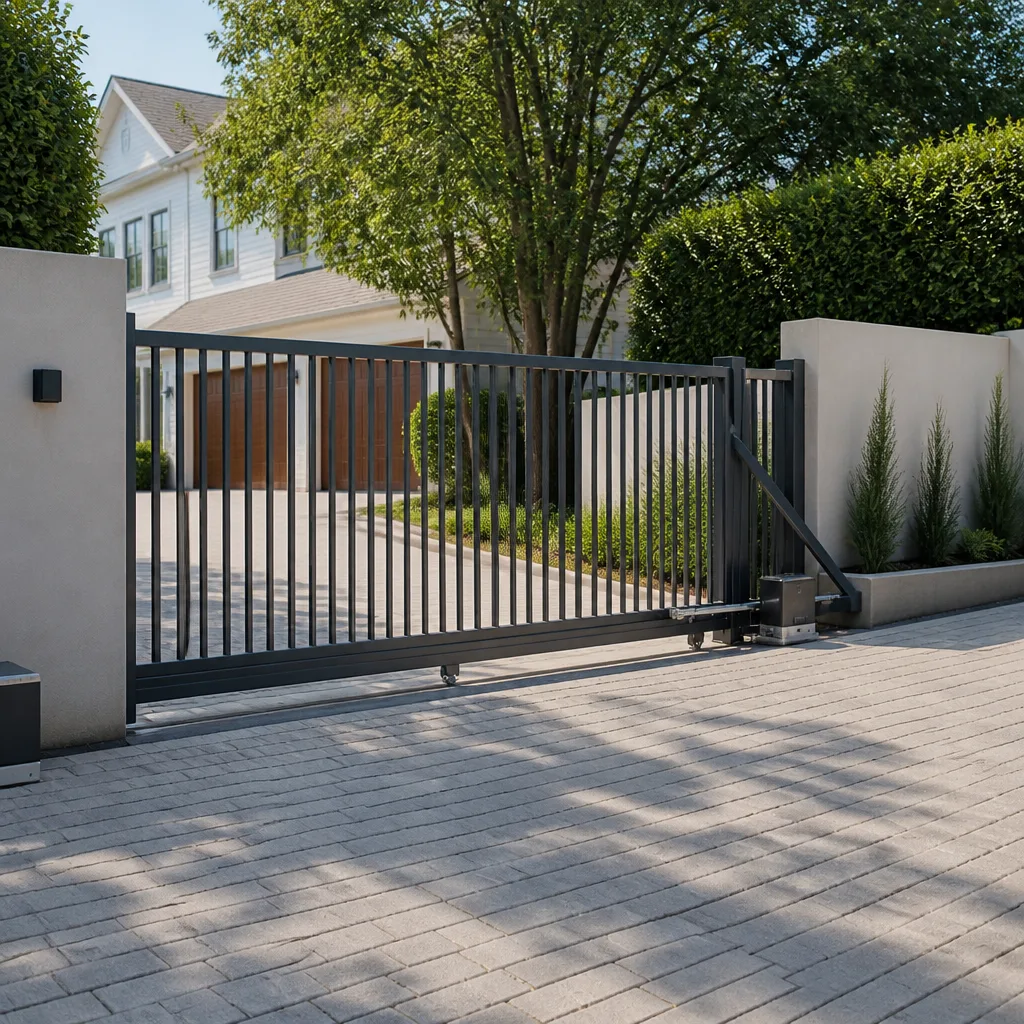 Sliding driveway gates
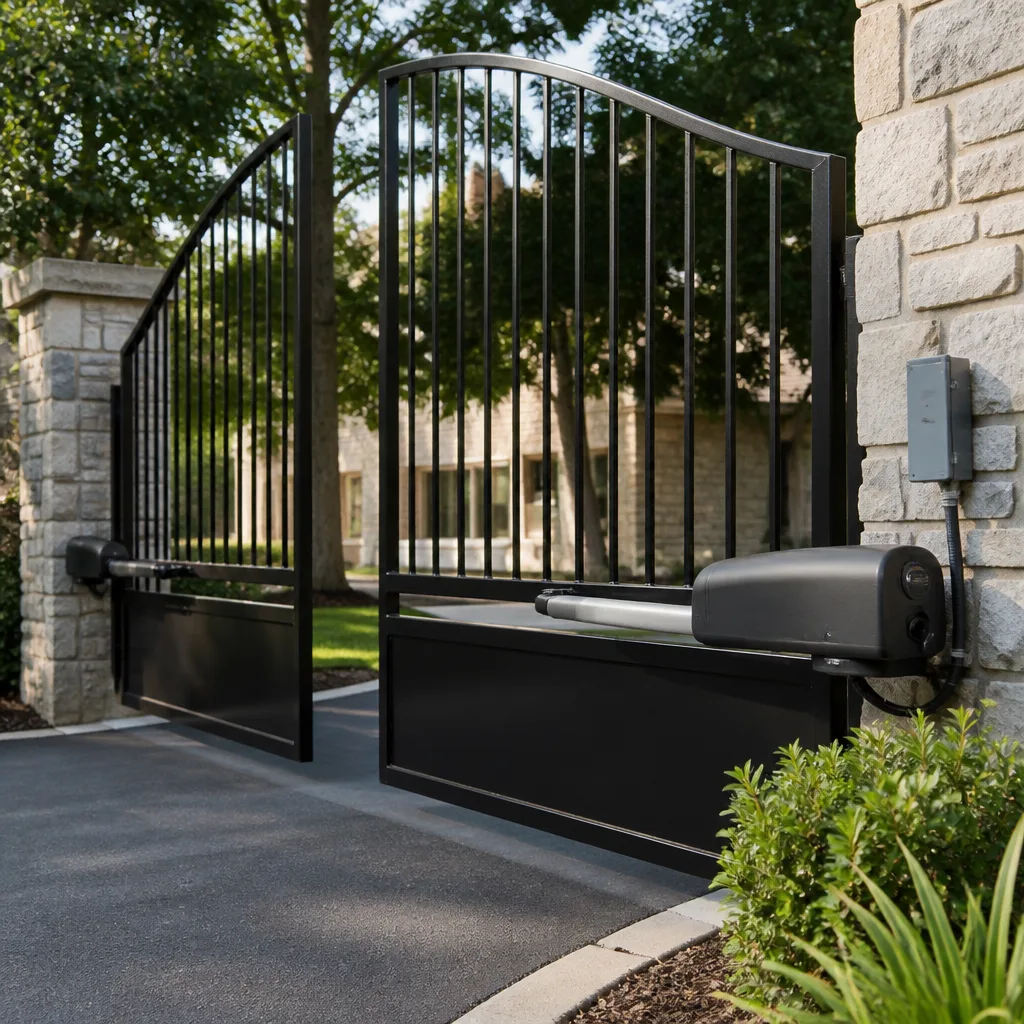 LiftMaster operators
Free on-site gate assessment - hinges, posts, and your LiftMaster or Nice gate operator checked before anything is quoted
The assessment is free and the quote is the invoice.
Get your free estimateThe Complete Gate Repair Guide for Riverside Homeowners
In the Inland Empire, the summer heat index regularly pushes gate operator circuit boards beyond their rated operating temperature, a fact most repair guides written for national audiences completely ignore. Your gate is not failing because it is old. It is failing because Riverside’s specific climate, hard water, and daily heat cycles are working against specific components in predictable ways. This guide gives you a systems-level view of your gate so you can diagnose accurately, prioritize repairs intelligently, and stop paying for the same fix twice. For more detail, see The Complete Guide to Gate Repair in Riverside.
Quick Answer
Most gate failures in Riverside trace back to a small set of climate-specific causes: intense UV degradation of plastic components, thermal expansion from triple-digit summers, and hard-water mineral buildup on hinges and hardware. A systematic diagnosis that starts with power, entrapment protection, and mechanical travel, rather than the operator itself, saves homeowners hundreds in misdiagnosed repairs. Understanding which repairs compound if deferred versus which can safely wait is what separates a lasting fix from a recurring one.
Styles & brands we work with
Table of Contents
- Why Riverside’s Climate Changes Gate Repair Rules
- The Anatomy of a Gate System: Component by Component
- The Correct Order of Diagnosis: What to Check First, Second, and Third
- Repair Triage: What Compounds, What Can Wait
- The Five Most Common Gate Failures We See in Riverside
- Permits and HOA Rules for Gate Work in Riverside County
- How to Choose a Gate Repair Company in Riverside
- Preventative Maintenance: What to Do Every Season
Why Riverside’s Climate Changes Gate Repair Rules
Riverside sits in a unique microclimate zone within the Inland Empire. Summer temperatures routinely exceed 100 degrees, with surface temperatures on metal gates and dark-colored operator housings running 30 to 40 degrees hotter. That means the internal electronics inside your gate operator are not experiencing 105 degrees, they are experiencing 135 to 145 degrees. Most residential gate operator control boards are rated for operation up to 158 degrees, which sounds fine on paper until you factor in the heat generated by the motor itself during operation. On a hot August afternoon in the Orangecrest or Mission Grove areas, a gate cycling open and closed for a contractor’s truck can push that board into thermal shutdown territory.
UV exposure is the second overlooked factor. Riverside averages over 270 sunny days per year. The plastic housings on safety sensors, keypads, and receiver antennas degrade faster here than in coastal cities. Plastic becomes brittle, seals crack, and moisture finds its way into electronics. We have replaced sensor housings that literally crumbled in our hands during removal, something you rarely see in San Diego or Orange County coastal service areas.
Then there is the water. Riverside Public Utilities and the areas served by CVWD consistently deliver hard water with high mineral content. When that water evaporates on gate hinges, roller tracks, and slide gate rollers, it leaves behind calcium and mineral deposits. Those deposits act as a mild abrasive, accelerating wear on moving parts. Over two or three years, a hinge that should last fifteen years can bind and seize. The gate still works, but the operator is now pushing against friction it was never designed to overcome, which shortens motor life and stresses the control board.
Understanding these local stressors matters because they change the repair calculus. A Gate Repair guide written for a national audience might tell you a hinge needs occasional lubrication. In Riverside, that hinge needs periodic descaling and lubrication with the correct product, or it will fail early and take the operator with it.
The Anatomy of a Gate System: Component by Component
A gate is not a single machine. It is a system of interacting components, each with its own failure signature. When you understand what each part does and what its typical failure looks like, you can communicate accurately with a repair technician and avoid being sold a repair you do not need. Here is the full breakdown.
The Operator (Motor)
The operator is the motorized unit that moves the gate. In residential systems, this is commonly a swing arm operator from brands like Mighty Mule or Ghost Controls, or a slide gate operator from LiftMaster or Elite. In commercial settings, you will see heavier operators from DoorKing, FAAC, BFT, or Viking. The operator’s job is straightforward: convert electrical energy into mechanical movement through a gearbox, chain, or belt drive. Its failure signature is usually a humming sound with no movement, a gate that starts and then stops, or a completely dead unit with no response at all.
Here is what matters for Riverside homeowners: operator lifespan in this climate is shorter than national averages suggest. The combination of high ambient temperatures and heat generated by the motor during operation degrades the internal lubricants and stresses the capacitor. A professional-grade operator that might last fifteen years on the coast often needs replacement in ten to twelve years here.
The Control Board
The control board is the brain. It interprets signals from your remote, keypad, or loop detector, and it manages the safety sensors. Modern control boards from LiftMaster, DoorKing, and FAAC are sophisticated pieces of electronics with diagnostic LEDs and programmable parameters. Their primary enemies in Riverside are heat and voltage fluctuation.
The failure signature of a control board is erratic behavior: the gate opens but will not close, the auto-close function stops working, remotes stop responding, or the gate operates on its own at random times. Sometimes a board simply fails entirely and nothing responds. Control board replacement is often more cost-effective than repair, especially on older units where multiple functions have degraded.
Safety Sensors (Photo Eyes and Contact Edges)
Entrapment protection is not optional equipment. UL 325 compliance requires that every automatic gate have a functioning entrapment protection system, which typically includes photo eye sensors that detect objects in the gate’s path and contact edges that reverse the gate upon physical contact. In Riverside, these components fail from UV-cracked housings, misalignment caused by shifting posts from thermal expansion, and wiring damage from rodents seeking shelter in the junction boxes.
The signature of a sensor failure is a gate that refuses to close, or reverses immediately upon touching the closed position. When a gate will not close, the first thing we check is the photo eye alignment and the contact edge resistance. Homeowners often assume the operator is failing when the real problem is a sensor that has drifted out of alignment.
Hinges and Rollers
For swing gates, the hinges carry the entire weight of the gate leaf while allowing smooth movement. For slide gates, rollers and guide wheels perform the same function. Riverside’s hard water is brutal on these components. Mineral deposits build up on hinge pins and roller bearings, creating friction that forces the operator to work harder. The early warning sign is a gate that moves noticeably slower than it did when new, or a visible sag on a swing gate.
Deferred hinge or roller maintenance is one of the most expensive mistakes a homeowner can make. A worn hinge set on a heavy steel gate puts lateral stress on the operator’s drive shaft and gearbox. The hinge replacement might cost a few hundred dollars. The operator replacement that follows if the hinges are ignored can cost thousands.
Loop Detectors
Loop detectors are the underground sensors that detect a vehicle’s presence and tell the gate to open or hold open. They are more common on commercial properties but appear on residential systems as well. A loop detector failure shows up as a gate that opens for remotes but not for vehicles, or a gate that refuses to close because it thinks a car is present.
Loop detector failures in Riverside are frequently related to the wire loop itself, which is buried in the asphalt or concrete and can be damaged by shifting ground from our seasonal wet-dry cycles. The detector box can also fail, but replacing the box without checking the loop continuity is a common shortcut that leads to repeat failures.
The Correct Order of Diagnosis: What to Check First, Second, and Third
When a gate stops working, most people assume the operator has failed. That assumption is wrong often enough that it costs Riverside homeowners real money. We recommend checking things in this specific order, because it mirrors the diagnostic sequence a competent gate repair specialist in Riverside follows on a service call.
- Power supply. Check the breaker, the GFCI outlet, and the on-off switch on the operator itself. A surprisingly high percentage of “dead” gates are simply without power. Check the LED indicators on the control board. If nothing is lit, you have a power problem before you have an operator problem.
- Entrapment protection. Look at the photo eye sensors. Are the lenses clean? Are they aligned (most have an alignment indicator light)? Are the wires intact? Check contact edges for visible damage. A tripped sensor prevents closure, and that is the system working as designed.
- Mechanical travel. With the operator disconnected (see your manual for the manual release), can you move the gate by hand? If it binds, scrapes, or requires significant force, you have a mechanical problem: a hinge, roller, wheel track, or post issue. The operator is working against friction it was not designed to handle.
- Operator function. Only after power, sensors, and mechanical movement are confirmed good should you evaluate the operator itself. Listen for humming without movement (capacitor or gearbox failure), check for burnt electrical smell, and look at the diagnostic LEDs on the control board.
- Access control devices. If the operator works but a specific remote, keypad, or intercom does not, the problem is in that access device, not the gate system. Test each device individually before calling for repair.
This sequence matters because it prevents misdiagnosis. A general repair company that does not specialize in gates might jump straight to operator replacement, because that is the expensive repair and the one they know how to sell. A Riverside gate specialist knows that a misaligned sensor or a seized hinge is far more common than a failed operator, and checking those first saves the customer money.
Repair Triage: What Compounds, What Can Wait
Not every gate problem requires immediate attention. Some issues compound if deferred and become expensive. Others are cosmetic or minor and can wait without consequence. Here is the triage framework we use when advising Riverside homeowners.
Fix Immediately (Compound if Deferred)
- Worn hinges or rollers. As described above, the operator is working harder every cycle. The hinge or roller repair is cheap relative to the operator replacement that follows.
- Failing safety sensors. Beyond the safety risk, a gate with non-functioning entrapment protection can auto-reverse constantly, which overheats the operator and shortens its life. This is also a liability issue.
- Sagging gate. A swing gate that has dropped and scrapes the ground is putting lateral load on the operator’s output shaft. The operator will fail, and that failure is preventable.
- Grinding or squealing noises. These indicate friction or bearing failure. Every noisy cycle is wearing something down. Noise is not a maintenance annoyance, it is a diagnostic signal.
Can Wait (Monitor and Address at Next Service)
- Cosmetic rust on non-structural areas. Surface rust on a gate panel is an aesthetic issue unless the rust is on hinges, wheels, or structural members.
- Faded powder coating. UV damage to the finish does not affect function. Repainting or refinishing can wait for a convenient time.
- Slowly degrading remote range. If a remote works from 30 feet instead of 50, the antenna or receiver may need attention eventually, but the gate still functions. Monitor it.
- Intermittent auto-close timing drift. If the gate occasionally stays open longer than set, the control board may be developing an issue, but it is not urgent if the gate still operates manually or on demand.
The key distinction is whether a neglected problem damages another component. Anything that increases friction, load, or heat on the operator is urgent. Anything that mainly affects appearance or convenience can wait.
The Five Most Common Gate Failures We See in Riverside
After years of electric gate repair work throughout Riverside, from the Wood Streets to La Sierra to Canyon Crest, these five failures account for the vast majority of our service calls.
1. The Gate Will Not Close
More often than not, this is a safety sensor problem, not an operator failure. The photo eyes have drifted out of alignment, a lens is dirty, the contact edge has shorted, or a wire connection has corroded. The control board is doing its job by refusing to close when it cannot confirm the path is clear. A technician who understands entrapment protection logic will check sensors before ordering a new board.
2. The Gate Runs Slow
A gate that operates noticeably slower than it used to is usually fighting mechanical resistance. Hard water deposits on hinges or rollers, a slightly bent post from a vehicle impact, or degraded bearing grease are the typical culprits. This is a warning sign that should not be ignored, because the operator is under stress every cycle.
3. The Operator Hums But the Gate Does Not Move
A humming sound with no movement points to a failed start capacitor or a stripped gearbox. Capacitors are relatively inexpensive and straightforward to replace on brands like Mighty Mule and Ghost Controls. A stripped gearbox is more serious and may warrant operator replacement depending on the unit’s age and condition.
4. Remotes Work Intermittently or Not at All
When a remote fob stops working, the battery is the first thing to check. If fresh batteries do not solve it, the problem is in the receiver, the antenna, or the remote’s programming. Control boards from LiftMaster, DoorKing, and Elite use different programming sequences, and a mismatch between the remote type and the receiver is common after a board replacement.
5. The Gate Opens or Closes on Its Own
Random operation is almost always a control board issue. Heat-related component degradation is a frequent cause in Riverside, particularly on boards that have been in service for more than eight years. Interference from nearby radio sources can also trigger phantom operations, but the control board is the first suspect.
Permits and HOA Rules for Gate Work in Riverside County
The rules for gate work depend on whether you are repairing or replacing.
Repairs: In most Riverside County jurisdictions, repair work on an existing gate does not require a building permit. Replacing a control board, operator, hinges, sensors, or other components is considered maintenance. However, if the repair involves modifying the gate’s structure, changing the gate’s dimensions, or relocating posts, a permit may be required.
Replacement and new installation: A full gate replacement or a new gate installation generally requires a permit through the City of Riverside Building and Safety Division or the Riverside County Building Department, depending on your jurisdiction. The permit process covers setback requirements, gate swing direction, and safety compliance with UL 325 standards for automatic gates.
HOA considerations: Many Riverside neighborhoods with HOAs, particularly gated communities in areas like Mission Grove, Alessandro Heights, and the newer developments in Orangecrest, have architectural review requirements for gate changes. Even a repair that changes the appearance of the gate may require HOA approval. If you live in an HOA-governed community, check your CC&Rs before scheduling a gate replacement. A professional gate installation company in Riverside should be familiar with local permitting requirements and can often help coordinate with HOA review processes.
Safety compliance: Any automatic gate system must comply with UL 325 entrapment protection requirements. This is not optional, and it applies to repairs, replacements, and new installations. A UL 325-compliant installation includes photo eyes, contact edges or equivalent entrapment protection, and appropriate warning signage.
How to Choose a Gate Repair Company in Riverside
Riverside has no shortage of handymen and general repair services that will take a gate call. The question is whether you want someone who fixes gates occasionally or someone who fixes gates exclusively. Here is what to look for.
Brand coverage. Not every gate company works on every brand. If you have a Linear operator and the company you called mainly installs LiftMaster, they may not carry the right parts or know the diagnostic codes. Ask specifically which brands the company services. A company that works on LiftMaster, FAAC, BFT, Viking, Ghost Controls, DoorKing, Elite, and Mighty Mule is going to be familiar with your system regardless of what you have.
Electric and automatic gate expertise. Mechanical gate repair and electric gate repair are different skill sets. A company that can weld a hinge but cannot diagnose a control board fault will leave you with a functioning gate that will not open automatically. Conversely, a company that understands motors and boards but does not handle mechanical wear will misdiagnose friction problems as electronic failures. You need both capabilities under one roof.
Diagnostic discipline. A competent gate specialist follows a diagnostic sequence, like the one outlined above, rather than jumping to the most expensive repair. Ask the technician what they checked and what they found. A good technician can explain the failure in terms you understand.
Local knowledge. A company that works regularly in Riverside knows the local climate stressors, the permitting landscape, and the HOA requirements. They also know that a gate on a Canyon Crest hillside lot faces different drainage and soil movement issues than a gate on a flat lot in La Sierra.
Riverside Gate Company is a dedicated gate specialist, not a general contractor that also does gates. We work on the brands you have, from the motor to the control board, and we handle repairs and new installations without subcontracting. When you call us, you get a gate specialist on the line, not a dispatcher reading from a script.
Preventative Maintenance: What to Do Every Season
Riverside’s climate makes preventative maintenance more valuable here than in milder regions. A seasonal maintenance routine catches small problems before they become operator replacements. Here is a practical schedule.
Spring (Pre-Summer)
- Descale hinge pins and roller bearings. Use a wire brush to remove mineral deposits, then apply a lubricant appropriate for your gate type. Avoid heavy greases that attract dust and grit.
- Check photo eye alignment and clean the lenses with a soft cloth. Summer heat will expand the gate and posts slightly, which can push sensors out of alignment.
- Inspect the operator housing for cracks or seal damage. UV degradation happens year-round but spring is the time to catch it before summer heat compounds the problem.
Summer (Peak Heat)
- Listen for changes in operation. A gate that runs slower on a 105-degree afternoon than on a 75-degree morning is telling you something about heat stress on the operator.
- Check that the operator’s cooling vents are clear of dust and debris. Restricted airflow compounds the heat problem.
- Monitor auto-close function. Thermal expansion can cause the gate to bind slightly at the latch point, which can trigger a false safety reversal.
Fall (Post-Summer)
- Inspect all wiring connections for heat damage. Wire insulation in Riverside degrades faster than national averages predict.
- Lubricate moving parts again. Summer heat thins lubricants and hard water evaporates faster in the heat, leaving more deposits.
- Test the manual release mechanism. Confirming it works before you need it saves a stressful situation later.
Winter (Rainy Season)
- Check drainage around the gate posts and the operator pad. Standing water accelerates corrosion and undermines post stability.
- Inspect the control board enclosure for moisture intrusion. Riverside’s winter rains are brief but intense, and a cracked housing will let water in quickly.
- Verify that the ground loop detector still functions correctly after seasonal soil moisture changes.
Some of these tasks are simple enough for a homeowner to handle. Others, like control board inspection and loop detector testing, require a Riverside Gate Company technician with the right equipment. A professional maintenance visit once a year is inexpensive insurance against a surprise operator replacement.
Common Mistakes to Avoid
- Ignoring a slowing gate. A gate that has gotten slower over time is not “just getting old.” Slowness means friction, and friction means the operator is working harder. Every week of ignoring it shortens the operator’s life.
- Lubricating with the wrong product. WD-40 is a solvent, not a lubricant. It strips away existing lubrication and leaves the metal more vulnerable to mineral buildup. Use a lubricant formulated for gate hardware, or ask a specialist what they recommend for Riverside’s specific conditions.
- Replacing the operator before checking the basics. Power, sensors, and mechanical movement need to be ruled out before the operator is condemned. Skipping this sequence leads to expensive misdiagnosis.
- Buying a replacement remote without confirming compatibility. LiftMaster, DoorKing, Mighty Mule, and Elite all use different frequencies, coding protocols, and programming sequences. A bargain remote from an online marketplace often will not pair with your receiver.
- Deferring safety sensor repairs. Beyond the safety risk to people and vehicles, a malfunctioning sensor causes constant auto-reversal, which generates excessive heat and shortens operator life. The sensor is a cheap fix compared to the damage it causes when ignored.
- Bypassing HOA approval for visible changes. Even a gate replacement that matches the original design can trigger HOA review. Skipping it can result in a demand to undo the work, which is far more expensive than filing the paperwork.
- Assuming a general handyman can handle electric gates. Electric gate systems involve control boards, entrapment protection logic, and brand-specific diagnostics. A mechanical repair without electrical expertise often addresses the symptom while leaving the underlying problem intact.
See the difference
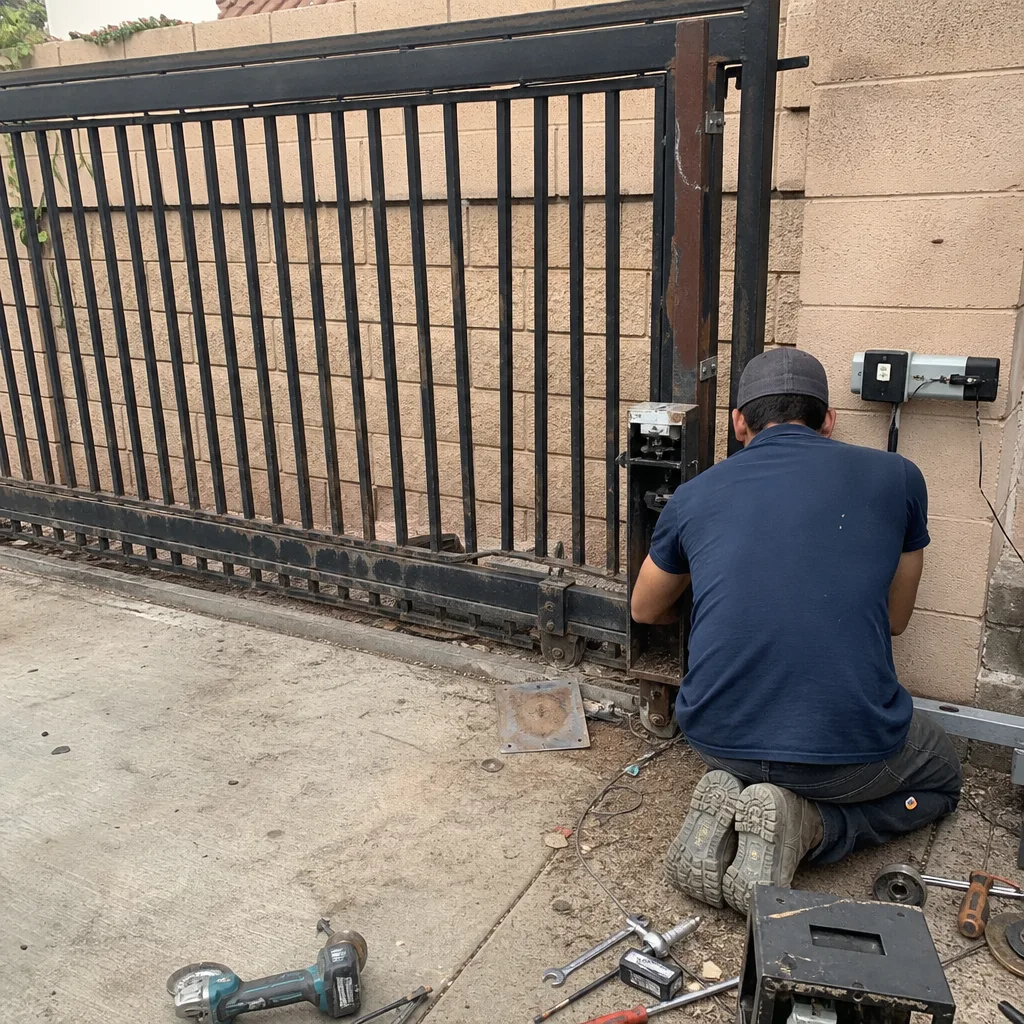 Before
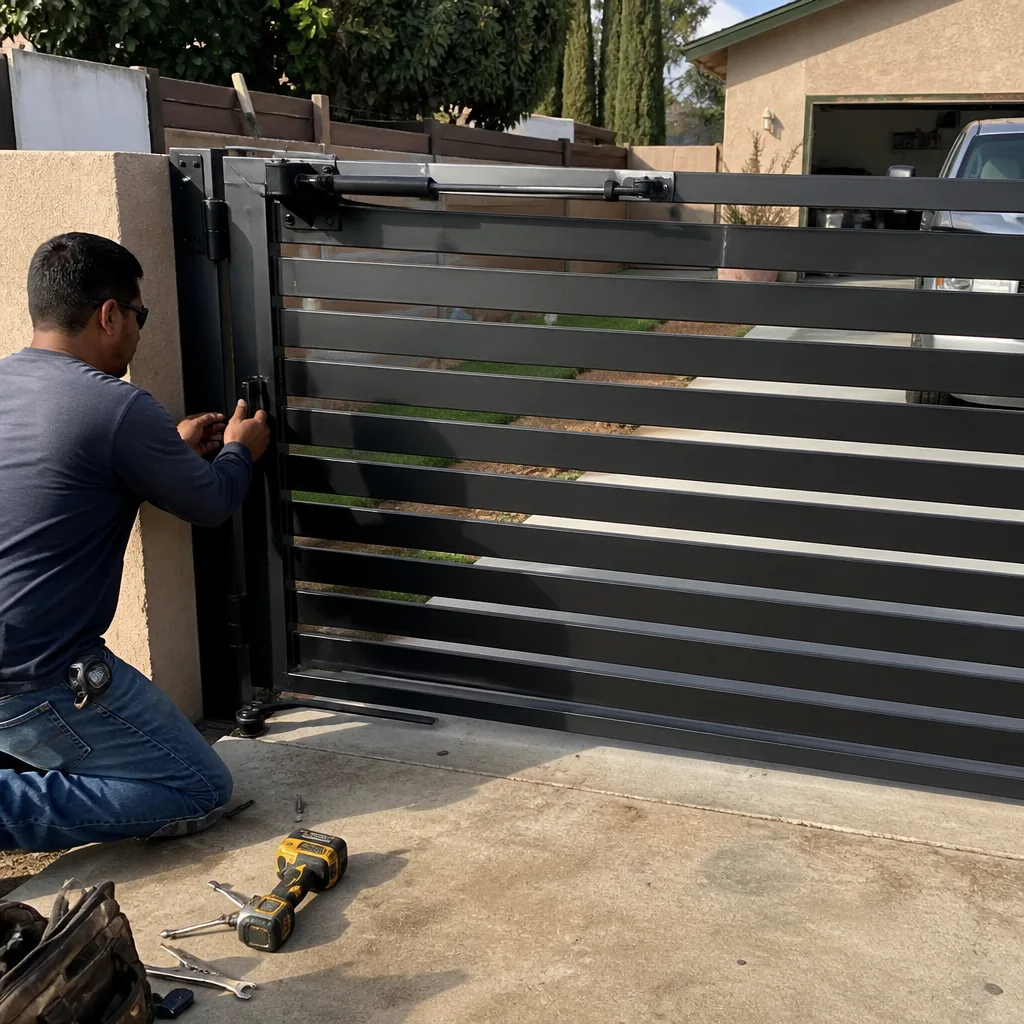 After
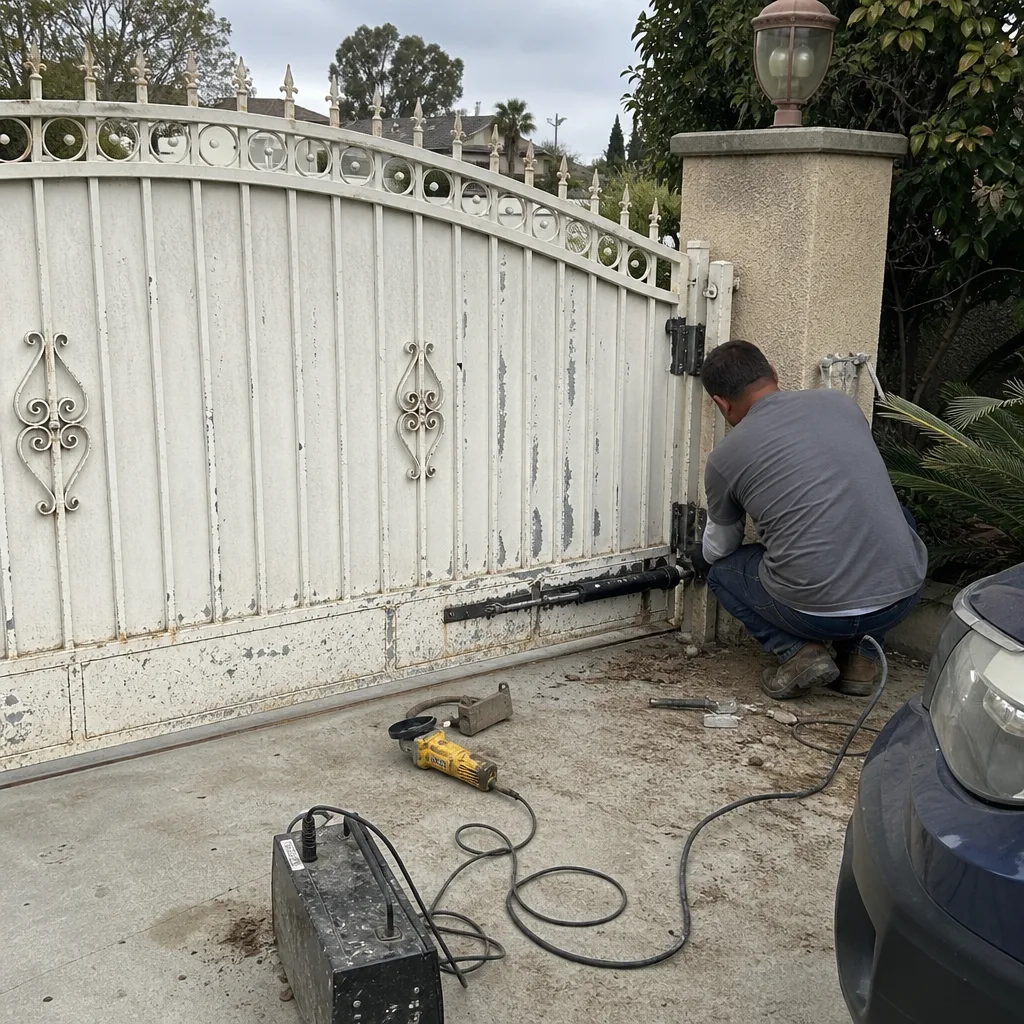 Before
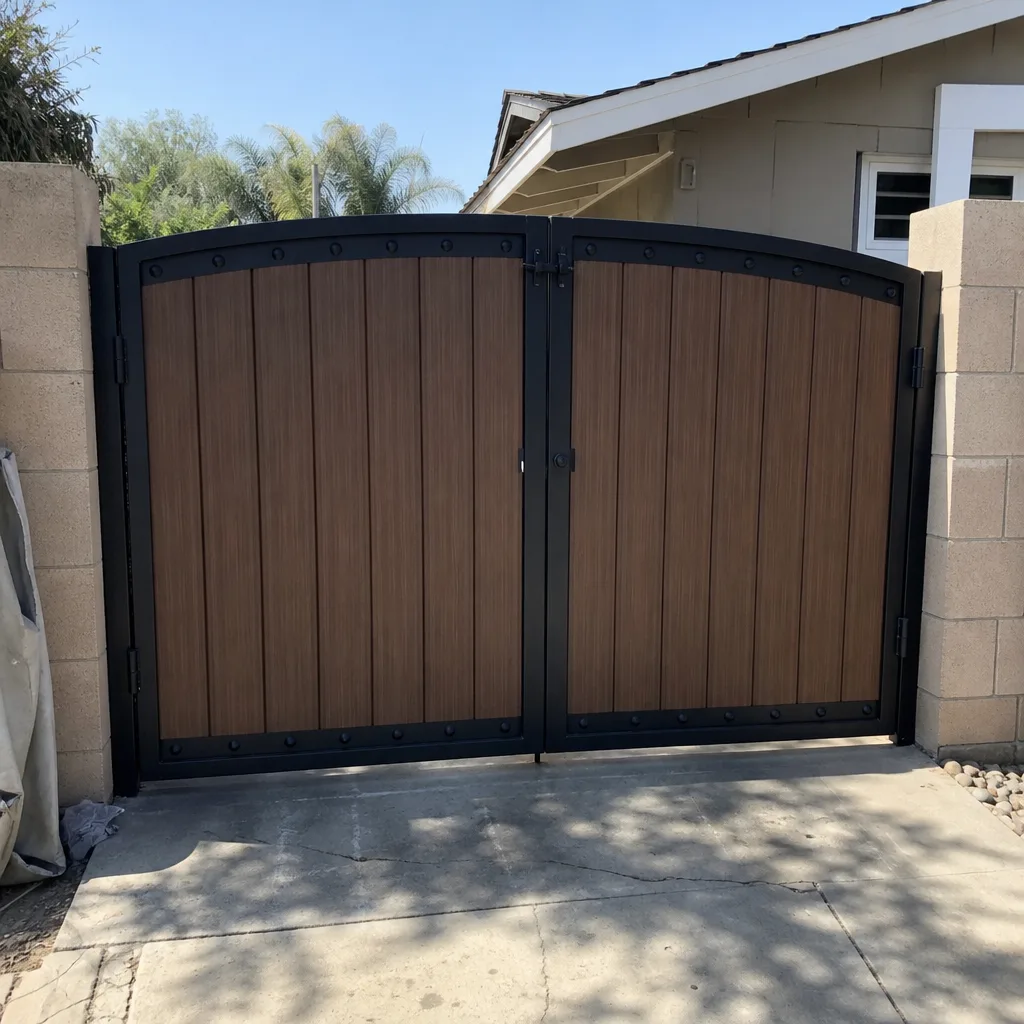 After
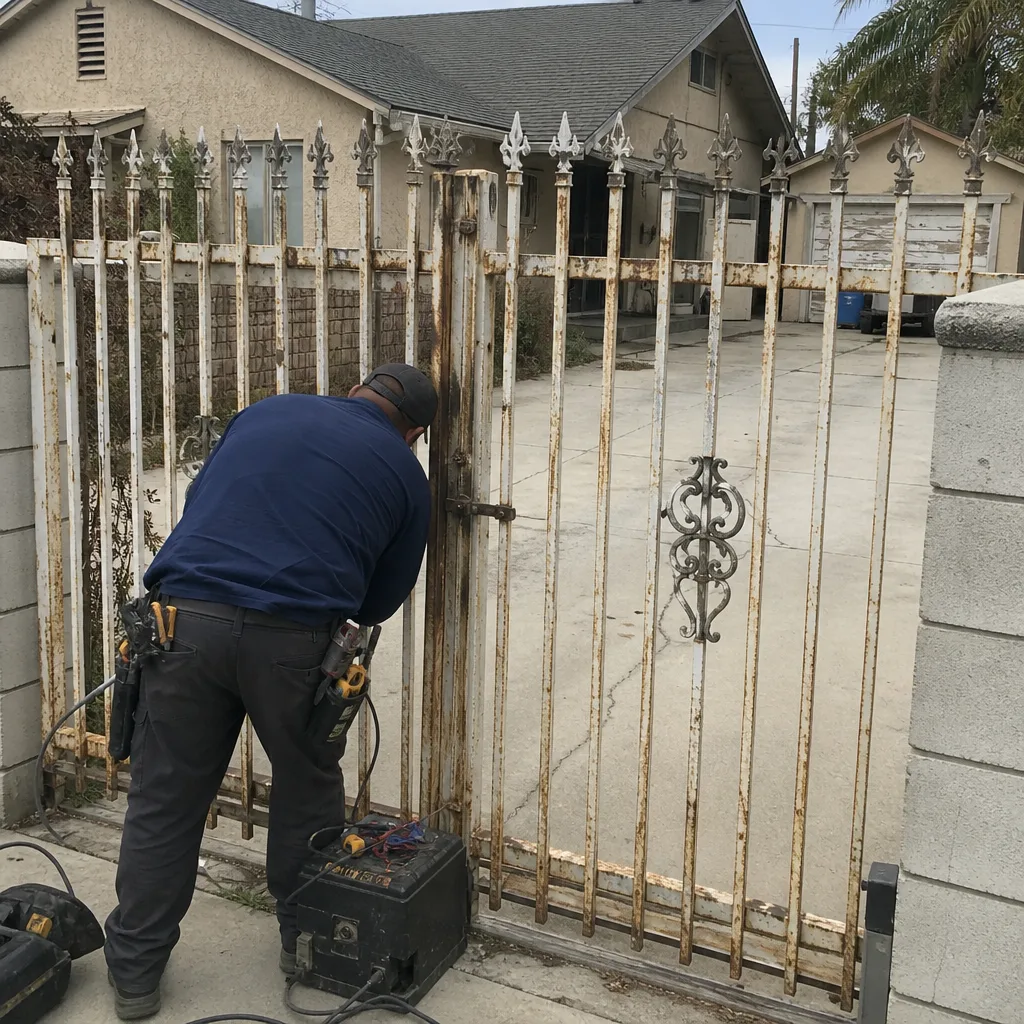 Before
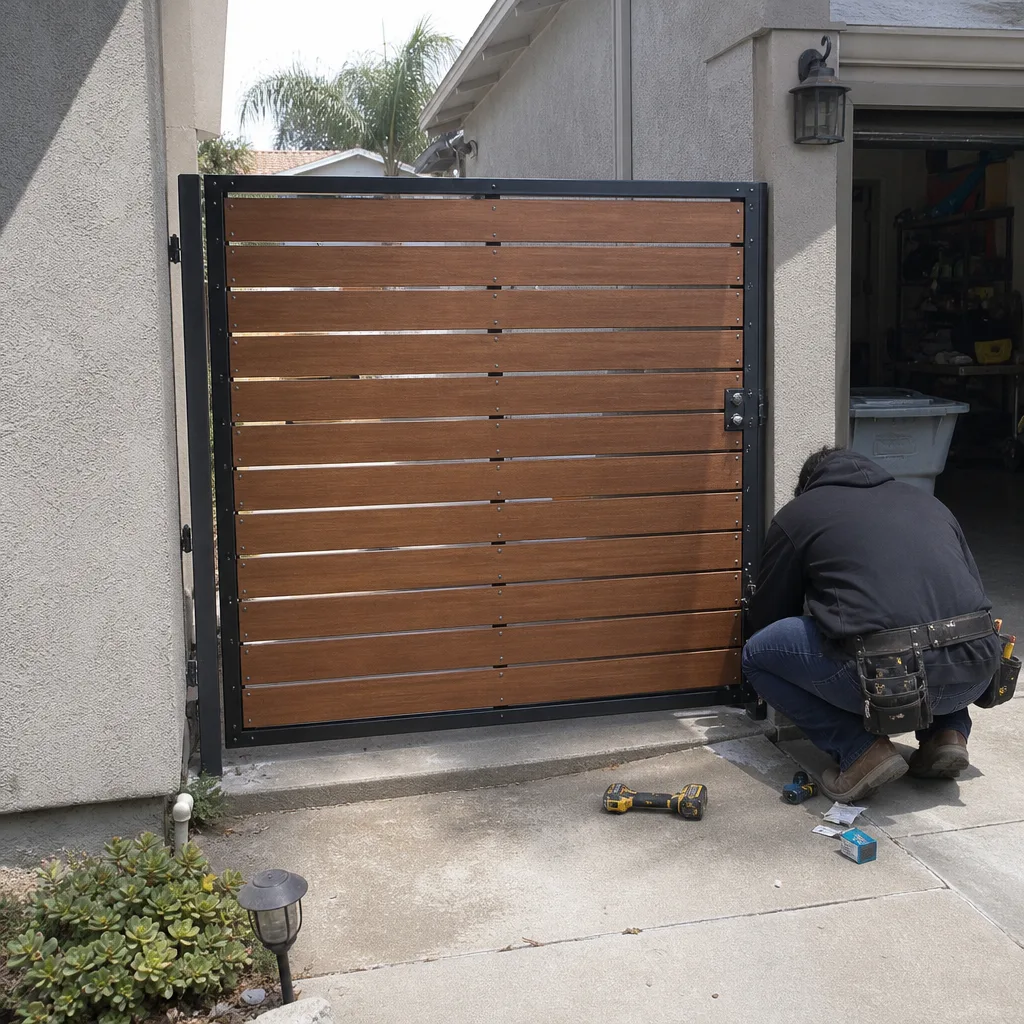 After
When to Call a Professional
Some gate repairs are genuinely DIY-appropriate: cleaning photo eye lenses, replacing remote batteries, tightening loose hardware. Others are not. See our DIY vs Professional Gate Repair: The Riverside Homeowner’s Decision Guide for help deciding. Call a professional when the operator hums but does not move, when the gate opens or closes on its own, when the control board shows error codes you do not understand, when a swing gate has sagged enough to scrape the ground, or when safety sensors have failed. Any issue involving the operator’s internals, the control board, or the entrapment protection system carries both safety risk and the risk of making the problem worse with an incorrect repair. Riverside Gate Company offers free estimates in Riverside, call (855) 942-4867 to schedule one. A qualified electric gate specialist can diagnose the problem accurately and fix it without replacing components that do not need replacing.
Frequently Asked Questions
Gate repair costs in Riverside vary widely depending on the component. Minor repairs like sensor realignment or remote programming typically run $85 to $150. Control board replacement ranges from $300 to $800 depending on the brand, with LiftMaster and DoorKing boards at the higher end. Full operator replacement runs $800 to $2,500 for residential systems, with commercial-grade operators from FAAC or BFT exceeding that. Call (855) 942-4867 for an exact quote, estimates are free.
In Riverside’s climate, a residential gate operator typically lasts 8 to 12 years, compared to 12 to 15 years in coastal Southern California cities. For more guides & resources on extending equipment life, visit our blog. The difference is heat stress on the control board and motor, plus UV degradation of housings and seals. Commercial operators, which are built with heavier-duty components, often last 15 to 20 years with proper maintenance.
For most common electric gate repairs in Riverside, same-day or next-day service is realistic. Components like sensors, capacitors, and remote receivers are frequently stocked on service vehicles. Control boards for less common brands may require ordering, which adds a few days. Riverside Gate Company stocks parts for the brands we service, including LiftMaster, DoorKing, Mighty Mule, and Elite, so most repairs are completed on the first visit.
Repairs to an existing gate generally do not require a permit, but a full gate replacement or new installation usually does. The City of Riverside Building and Safety Division and Riverside County Building Department both regulate gate installations, and HOA-governed communities may have additional architectural review requirements. A professional gate installation company should handle permit coordination as part of the project.
A gate that stops midway and reverses is almost always responding to a safety sensor signal. The photo eyes may be misaligned, dirty, or failing, the contact edge may have a short, or the gate may be encountering actual mechanical resistance that triggers a false entrapment detection. Check the sensor alignment and clean the lenses first, then call a specialist if the problem persists.
We service nine major gate automation brands: LiftMaster, FAAC, BFT, Linear, Viking, Ghost Controls, DoorKing, Elite, and Mighty Mule. Our brand coverage spans DIY-grade residential systems like Mighty Mule and Ghost Controls through professional-grade commercial operators like FAAC, BFT, and DoorKing. If your gate has an operator from one of these brands, we work on it. Call (855) 942-4867 to confirm your specific model.
The Bottom Line
Riverside’s climate, heat, UV, and hard water, degrades gate components faster than national averages predict. The gate system is more than its operator, and most failures trace back to sensors, hinges, rollers, or power supply issues rather than a dead motor. Systematic diagnosis in the right order saves money, and triage helps homeowners prioritize repairs that compound versus those that can wait. Preventative maintenance, appropriate lubrication, and prompt attention to slowing or binding gates extends operator life and prevents expensive replacements. When in doubt, a dedicated gate specialist with experience in Riverside’s specific conditions is the most cost-effective call you can make.
Written by the team at Riverside Gate Company, serving Riverside since 2011.
If your gate is acting up, misbehaving, or just not moving the way it should, call (855) 942-4867 today. We will diagnose the problem accurately, quote the repair before any work begins, and fix it right the first time.